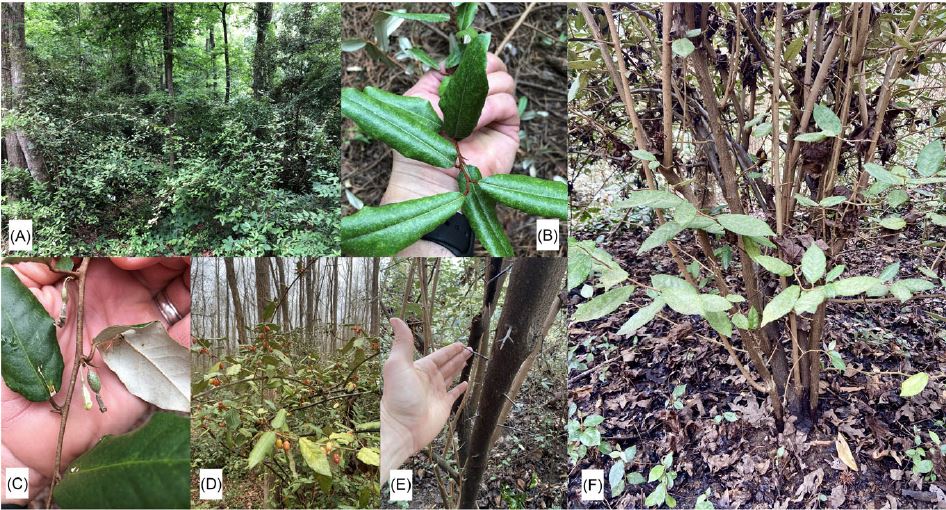
Several Elaeagnus species (autumn olive [Elaeagnus umbellata Thunb.], Russian olive
[Elaeagnus angustifolia L.], and thorny olive [Elaeagnus pungens Thunb.]) are invasive in North
America. Elaeagnus pungens is prevalent throughout much of the southeastern United States,
commonly overtaking wooded and natural areas, bottomlands, and roadsides. While many
management methods, including several herbicide treatments, have been evaluated, the efficacy
of these methods can vary based on the size and density of the target plants. Further, personal
communication with land managers revealed a lack of information that incorporated
application effort, duration, and associated cost into treatment efficacy and usefulness. We
evaluated three herbicide application methods using the free acid formulation of triclopyr in an
E. pungens–infested forest in South Carolina, USA, to determine the effectiveness of each
application method. We estimated pretreatment E. pungens biomass and destructively
harvested all live material posttreatment to obtain actual biomass values. Foliar herbicide
application was ineffective, but both cut stump and basal bark application nearly eliminated E.
pungens in the treatment plots. The basal bark application took slightly more time to complete
than cut stump treatments but was described as less physically demanding by applicators. Based
on treatment efficacy and time required, the basal bark application method seems most prudent
for controlling E. pungens in these areas. These results will help land managers more effectively
use their resources for invasive woody plant control.
A comparison of different chemical controlapplication methods for managing Elaeagnus pungens in South Carolina