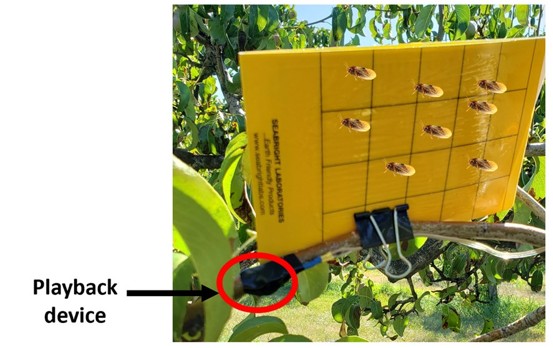
Integrated pest management programs often use pesticides alongside behavioral tactics, such as mating disruption, to manage pests. Pest management using biotremology, the study of vibrations produced by organisms, is gaining attention but requires substantial knowledge of pests and their environment. Here, we built on previous characterizations of vibrational mating signals in pear psylla to assess if pear psylla (Cacopsylla pyricola Förster) communication behavior can be exploited for pest management. Specifically, we conducted greenhouse experiments to test the efficacy of 3 vibrational playback treatments for mating disruption: (i) control, (ii) white noise, and (iii) male mating signals, using 2 delivery methods: (i) plant substrate and (ii) trellis wire; these 2 methods assessed whether devices attached directly to pear saplings or trellis wire supporting saplings provided similar results. We also conducted experiments in pear orchards to assess effectiveness of vibrational playbacks as trap supplements. In the greenhouse, white noise and male mating signals delivered through plant substrates reduced pear psylla offspring in 1 of 3 experiments, but never when delivered through trellis wires. Sticky traps in orchards supplemented with vibrational signals trapped more adults and females than sticky traps alone. The results of this study suggest that pear psylla vibrational communication may be exploited for pest control and pest monitoring, but variable efficacy among experiments suggests a need for further examination into delivery methods.
Potential use of vibrational playbacks for management of pear psylla